Chelsea Technologies, Forcys, and Wavefront Systems have formally merged under the Forcys brand. This integration strengthens the new company’s ability to meet the evolving demands of the defence sector and other critical markets, while reinforcing its position as a technical leader in the provision of underwater solutions. The move reflects a continued commitment to innovation and collaboration.
The newly combined organisation will bring together decades of expert engineering excellence, creating a stronger, more integrated offering for customers in defence and security, while continuing to serve blue technology sectors.
Paul Badger, CEO of Forcys, stated: “Combining the three organisations provides us with the critical mass required to deliver against a more ambitious vision. With underwater threats to our critical national infrastructure and peer adversaries that increasingly rely on autonomous platforms, we need to be ready to meet the mission head-on. We are doing exactly that.”
Building on a record-breaking period of defence deliveries, the combined Forcys team is well positioned to help the industry navigate the shift from traditional systems toward a more autonomous future. The new entity will be ideally placed to deliver integrated underwater payloads to support a range of missions from ISR to underwater intruder detection and deterrence.
Ioseba Tena, CCO of Forcys, stated: “Building on the proven defence pedigree of Chelsea Technologies and Wavefront Systems, we are integrating world-class expertise to help our customers outperform the competition by delivering increased value through our integrated underwater sensing solutions. We are confident that this is the right team at the right time to lead the next chapter of industry innovation.”
While the Forcys name will represent the new organisation, Chelsea Technologies will continue as a product brand within the new structure, retaining its long-standing reputation and presence within the blue technology sector providing specialist sensing and water quality monitoring.
This is not an acquisition. It is a coming together of three companies within the same group. The three organisations seek to amplify their impact, improve efficiencies, and better serve customers across all sectors.
Submarine rescue is one of the most time-critical and technically demanding missions in naval operations. When a submarine is disabled on the seafloor, every hour matters. Survival depends on how quickly the vessel can be located, assessed, and successfully mated with a rescue system. Advances in autonomous undersea technology now offer a clear path to dramatically improving these outcomes.
Modern autonomous underwater vehicles (AUVs), remotely operated vehicles (ROVs), and uncrewed surface vessels (USVs) can accelerate every phase of a rescue operation. Wide-area search using Multiple Aperture Sonars (MAS) such as Forcys’ Solstice MAS, along with magnetometers and other techniques enables rapid localization with far greater coverage and resolution than traditional methods. Once located, autonomous systems equipped with high-resolution MAS, optical, and laser scanning can generate detailed 3D models of the submarine and surrounding seafloor, allowing rescue planners to assess hull condition, slope, and obstructions before committing rescue assets.
Autonomy also plays a critical role during the most challenging phase of rescue: approach and mating. Precision navigation, vision-in-the-loop control, and automated alignment reduce the possibility of failed docking attempts and improve the reliability of transfer-under-pressure operations. The result is faster rescue cycles and a higher percentage of survivors safely recovered.
These capabilities build directly on existing systems such as the U.S. Navy’s Submarine Rescue and Diving Recompression System (SRDRS) and NATO’s Submarine Rescue System (NSRS), enhancing them with speed, resilience, and data-driven decision-making. At Forcys, we believe that integrating autonomy into submarine rescue is not a future aspiration—it is a practical, achievable step toward saving lives when time matters most.
We’ll be exploring this subject in more depth at the upcoming NATO Submarine Escape and Rescue Working Group (SMERWG) event in London at the end of January.
To meet the growing complexity of modern mine countermeasure missions, Forcys and Eelume have joined forces to deliver a new class of agile autonomous capability. Pairing Eelume’s manoeuvrable autonomous underwater vehicle (AUV) platform with Forcys’ integrated sonar and optical systems from Wavefront Systems and Voyis, will enables navies to locate, assess and confirm underwater threats with greater certainty across complex seabed terrain.
Together, these technologies mark a major advance in autonomous and networked mine countermeasure operations, allowing smaller and smarter systems to deliver the same certainty and coverage once limited to large, manned vessels.
Clearing and securing coastal waters, harbours and confined seabed areas remains one of the most difficult tasks faced by navies today. Conventional AUVs are optimised either for endurance or manoeuvrability, rarely both. In shallow or topographically complex terrain, these limitations create data blind spots, forcing navies to rely on slower and less certain minesweeping techniques.
Thomas Nygaard, CEO at Eelume, said, “Modern mines hide in the most challenging seabed environments — among rocks, slopes and narrow channels that traditional AUVs can’t fully access. Eelume S combines detection, classification and identification in one system, eliminating the need for ROV operations and reducing time-consuming mine sweeping through its manoeuvrability, advanced sensor suite and in-mission processing capabilities. This keeps personnel and vessels out of the minefield and makes MCM safer, faster and more efficient.”

The challenge lay in developing a compact, versatile platform that could deliver both wide-area detection and detailed inspection in any seabed environment, from open waters to confined littoral zones, without compromising range or endurance.
Forcys acts as the integrator of a powerful ecosystem of subsea technologies, bringing together proven innovations from across its group to deliver fully optimised solutions for the end user.
Through the integration of Wavefront Systems’ multi-aperture sonar Solstice and Voyis’ optical imaging systems, Forcys will enable Eelume S to achieve both the wide-area efficiency and close-range fidelity essential to modern MCM missions.
- Solstice delivers image quality close to synthetic aperture sonar (SAS) but at roughly one-tenth of the data burden and with substantially lower power demand. Its tolerance to platform motion makes it ideal for shallow-water and high-relief environments, requiring frequent manoeuvres, where SAS systems are less effective.
- Voyis Observer Imaging System provides high-resolution stills with true-colour representation, enabling rapid visual identification of potential threats once detected.
By acting as a single integration partner, Forcys ensures the optimal synergy between vehicle, sonar and camera systems, streamlining deployment and simplifying logistics for naval customers.
The Solution
The Eelume S platform introduces a flexible, bio-inspired propulsion system featuring dual counter-rotating propellers mounted on an articulated tail. This design grants independent control of pitch, yaw, and roll, allowing the vehicle to move fluidly around obstacles, maintain stability close to the seabed, and capture detailed sensor data in environments inaccessible to conventional AUVs.
Equipped with Forcys’ integrated sensor suite, Eelume S can perform wide-area sonar sweeps to detect and classify objects before transitioning seamlessly to close-range optical inspection for identification. The system’s compact size makes it easy to deploy from uncrewed surface vessels (USVs) for extended, fully remote multi-vehicle operations.
In trials across Norway’s complex coastal terrain, the platform demonstrated consistent area coverage and the ability to deliver actionable, high-resolution data at a fraction of the bandwidth normally required for SAS missions.
Thomas Nygaard, “We outperform traditional AUVs, not just on complex bathymetry, but also on flat seabeds because we can operate closer to the seabed and capture higher-quality images. With the Solstice MAS sonar integrated we get the best of both worlds, combining agile movement with the data quality needed to act quickly on targets.”
The Result
The integration of Eelume S with Forcys’ advanced sonar and imaging systems represents a major evolution in mine countermeasure capability.
The combined system enables Detection, Classification and Identification (DCI) from a single AUV, reducing mission time and complexity while increasing operational certainty.
The solution delivers:
- Greater operational certainty: Precise detection and identification even in confined, high-relief seabeds.
- Enhanced safety and efficiency: Reduced reliance on crewed minesweeping, minimising risk to personnel.
- Scalable autonomy: Compatibility with USVs and networked MCM concepts for coordinated multi-vehicle operations.
- Reduced data burden: Actionable information at lower bandwidth and power consumption, enabling faster mission processing.
For countries like the UK, where complex littoral zones, busy ports and vital offshore infrastructure demand reliable protection, this capability provides an agile and interoperable tool that enhances both national and NATO defence readiness.
Justin Hains, Forcys Business Development Manager, commented; “This collaboration with Eelume demonstrates how Forcys is enabling navies forces like the Royal Navy to operate more effectively in challenging environments previousy considered unhuntable. The integration of Wavefront Systems MAS and Voyis imaging on the Eelume AUV delivers detection, classification and identification from a single platform, a capability proven in Norway’s fjords where traditional AUVs fail due to complex bathymetry. For UK missions at home and deployed, this means faster, safer and more reliable coverage across critical littoral zones.”


By bridging innovation and integration, Forcys and Eelume are transforming how the world’s navies see, understand, and secure the underwater domain.
EURONAVAL 2026 will take place from 3rd to 6th November 2026 in Paris Nord Villepinte. EURONAVAL is a meeting place for all countries concerned by the protection of maritime areas and safety at sea and from the sea.
Forcys and its technology partners demonstrated world-class undersea defense capabilities at this year’s BlueTIDE Challenge and Technology Showcase, held at the Naval Undersea Warfare Center Newport Division and Sail Newport marina. The team secured two major awards, underscoring Forcys’ leadership in protecting critical undersea infrastructure.
In the technical challenge, Sentinel Intruder Detection Sonar won the top prize in the Sensor category, taking home USD 50,000 and industry recognition for its performance in live conditions. The system competed successfully against 15 rival technologies and showcased the potential of D-SWAAT, a new active tracking mode designed to extend Sentinel’s range and effectiveness.
At the concurrent technology exhibition, Forcys partnered with Voyis, EIVA and VideoRay to deliver a live Visual Simultaneous Localisation and Mapping demonstration. The showcase impressed judges and attendees, earning the prize for Best In-Water Demonstration.
The event brought together 20 companies to a live competition and more than 40 exhibitors from across the undersea domain, attracting over 600 registered visitors. The outcome highlights how Forcys’ integrated technologies, ranging from advanced sonar to vision-based mapping, are enabling navies and infrastructure operators to strengthen security and resilience beneath the surface.
“BlueTIDE is about pushing the boundaries of undersea innovation in real-world scenarios. Winning in both the competitive challenge and the demonstration showcase reflects not just the capability of Sentinel and VSLAM, but also the power of collaboration across our partner ecosystem. It was a true team effort and a proud moment for everyone involved.”
Chris Haugen, Business Development, Forcys Inc. (CAPT, USN Ret.)

On 29-30 September 2026 at Olympia, London, join us at the International Security Expo. This event has an unrivalled and long-established reputation as the go-to event for those working at the highest-levels of the global security industry .
The Indo Pacific International Maritime Exposition is the region’s premier commercial maritime and naval defense exposition, connecting Australian and international defense, industry, government, academia and technology leaders, in the national interest. The exhibition is held from the 4th to the 6th of November.
Join us in Perth Australia on the 26-28th of May for the Indian Ocean Defence & Security (IODS) 2026 Conference and Exhibition. A a strategically focused international defence and security event designed to facilitate high-level engagement on shared regional challenges, capability development, and sovereign industry growth.
Global maritime defense company Forcys has confirmed the delivery of Sentinel IDS® Expeditionary Trailers to a long-standing defense customer.
Developed by our technology partner Wavefront Systems, the Sentinel Expeditionary Trailer is a fully self-contained, mobile security unit that provides rapid and effective underwater protection for defense forces operating in remote or infrastructure-limited environments. Designed for quick deployment and maximum mobility, the system offers enhanced situational awareness wherever it is required.
Each trailer houses the world-leading Sentinel Intruder Detection Sonar which can detect and classify divers at ranges of up to 1,000 meters and unmanned underwater vehicles (UUVs) at up to 1,500 meters. The compact trailer-based configuration allows Sentinel to be deployed where fixed infrastructure is unavailable or unsuitable, making it an ideal solution for expeditionary and forward-operating missions.
Founded in 2022 and built on a legacy of over five decades in the underwater domain, Forcys continues to be trusted by navies and defense organisations around the world.
Delivering more modern and more capable defense solutions, through next-generation situational awareness technology that provide mission-tailored underwater intelligence and control.
This latest delivery reflects the growing international confidence in Forcys and Wavefront’s ability to supply integrated systems built for operational flexibility and effectiveness.
Ioseba Tena, Managing Director at Forcys, commented: “This new offer makes it even easier to arrive on site, deploy the sonar and secure your perimeter. With ongoing developments it’s no surprise that Sentinel is still the world’s most widely deployed intruder detection system, keeping people and assets safe from underwater threats, anywhere, anytime.”
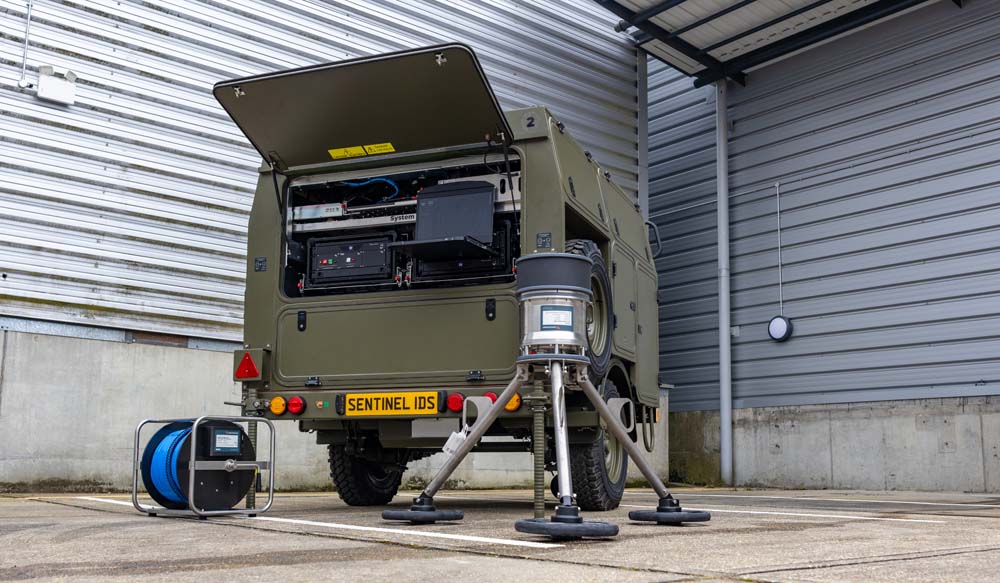
The Sentinel IDS® Expeditionary Trailer can be explored in more detail via the Wavefront Systems website.
Attendees at the Combined Naval Event (CNE) 2025 are invited to visit the Forcys stand to meet the Team and learn more about the Expeditionary Trailer as well as Forcys latest innovations in maritime defense.