In brief
One person-portable remotely operated vehicle (ROV) systems are increasingly being counted on to deliver support to expeditionary forces conducting underwater operations. Used to inspect and to help deploy payloads at significant depths, combat and EOD divers can count on these ROVs to provide intelligence ahead of a dive. Now packed with automation features, new generation micro ROVs have become precise inspection tools.
The challenge
Your warfighters are increasingly being relied upon to deploy, operate, and maintain complex tools in support of their operations. Diving teams have it harder than most as they need to deploy these tools underwater against currents, with low visibility and poor positioning references.
The solution
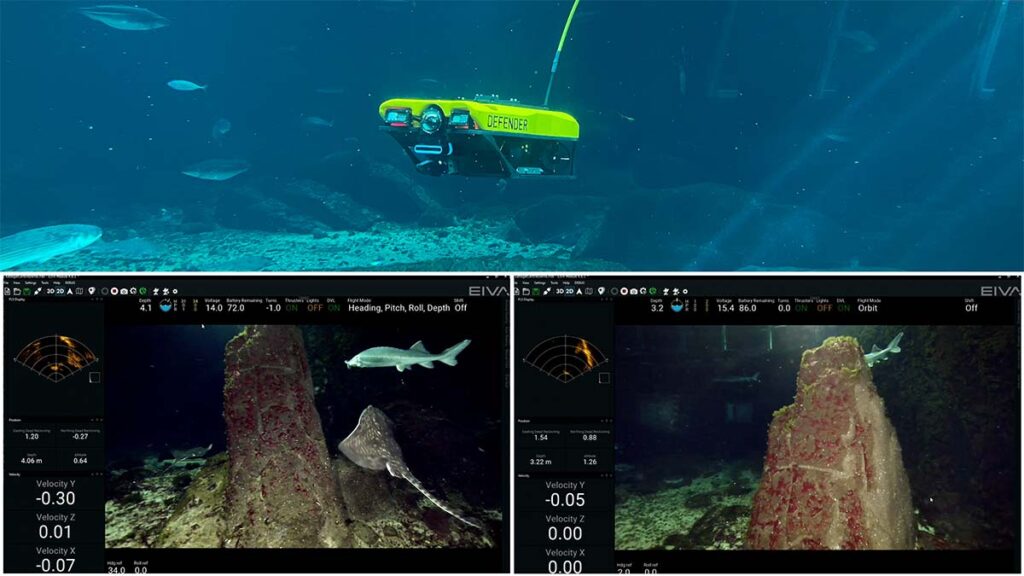
Developed by our technology partner EIVA, NaviSuite Mobula is a complete ROV software package with many advanced features for automatically and efficiently planning and performing ROV inspections, as well as enabling powerful data processing so operators can easily create high-quality, comprehensive data deliverables. Fully integrated from the factory with Defender ROVs from VideoRay, it provides your warfighters with a simple to use fly-by-wire control system. It delivers faster re-acquisitions and better data from which to make decisions.
The result
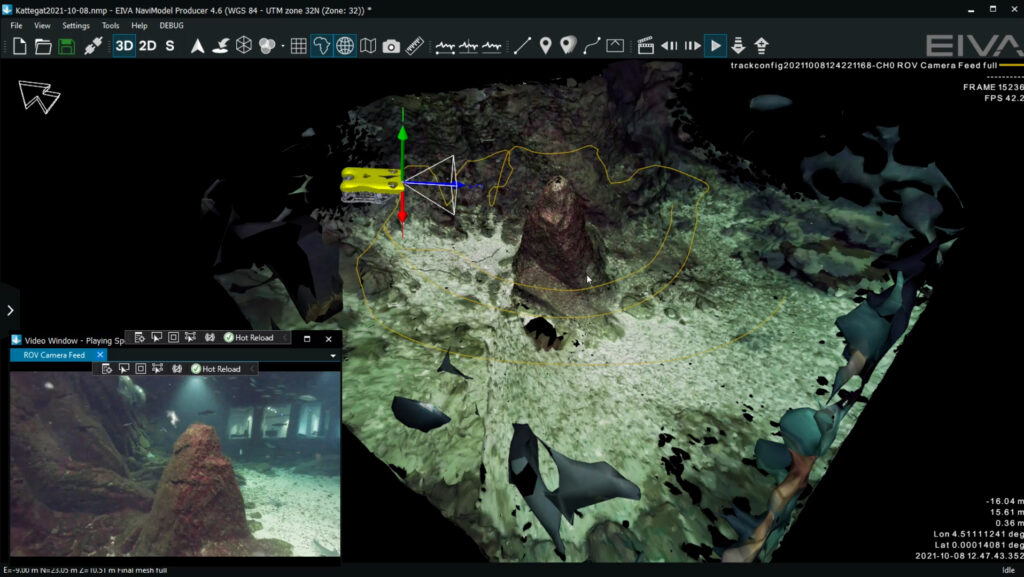
Combining NaviSuite Mobula with a micro ROV makes controlling the ROV a simple task. You can configure the user interface to suit your preferences. Flying the ROV is simple, simply drop a waypoint or select a set distance and direction and the ROV will automatically fly to that location. Use 2D, 3D and 4D model visualisations to improve your situational awareness. It’s also equipped with automatic sonar data cleaning and navigation processing tools that deliver improve your deliverables. In addition, it’s capable of generating fly-by videos or 3D visualisations to support your reporting and decision making. NaviSuite Mobula delivers actionable results enabling your warfighters to focus on information and not the process of acquiring it.
Forcys can enhance your experience with other innovative, advanced tools such as wireless acoustic initiation triggers, inertial navigation systems or optical systems from our technology partners at Sonardyne and Voyis. We can also support your autonomy programme with the integration of automatic target recognition using NaviSuite Deep Learning, or VSLAM computer vision, which lets you create 3D models using a single camera.
NaviSuite Mobula supports Defender ROV users, but it you would like to consider this innovative system to enhance a different platform please contact us.
We look forward to helping you with your requirement.
Forcys brings together leading technologies, offering a comprehensive naval and subsea capability to the defence market.
Forcys brings to market world-changing solutions from leading technology partners Chelsea Technologies, EIVA, Sonardyne, Voyis and Wavefront. Backed by over fifty years of experience, Forcys offers the global maritime defence sector, remote, autonomous and networked control capabilities that deliver integrated situational awareness to customers in the underwater domain.
Covering a range of maritime operations including asset protection, littoral strike, mine warfare, submarine rescue, and submarine and anti-submarine warfare, Forcys draws on the extensive experience and expertise from across its technology partners to offer a comprehensive capability to the market.
Commenting on the launch, Ioseba Tena, Commercial Director of Forcys, said:
‘Our technology partners have a strong and proven pedigree in the undersea domain, one that offers trusted capabilities to our customers. In bringing these services and technologies together under Forcys, we are not simply providing technologies that address the challenge our customers face today, but ensuring they are able to meet the operational requirements of tomorrow with comprehensive, integrated solutions.’
Forcys will continue to support customers with full lifecycle management in meeting mission requirements, including integrated solutions, consultancy, concept and assessment, customised project management and integrated logistics, to help them meet capability requirements efficiently whilst minimising risk.
Justin Hains MBE, Business Development Manager for Forcys, explains:
‘By combining our extensive experience and expertise, we are creating an ecosystem for sharing knowledge and insights with our technology partners, helping us to meet our customers’ operational needs, now and in the future. This not only enhances our ability to offer the best possible solutions to the market, it creates a more efficient and more cost-effective engagement for our customers.’
Forcys is exhibiting at the Undersea Defence Technology exhibition at the Rotterdam Ahoy between 7th and 9th June 2022 at stand C6. If you’d like to arrange a meeting with the Forcys team, please get in touch.
In brief
L3Harris AUV Systems’ customer chose Mini-Ranger 2 Ultra-Short BaseLine (USBL) aided navigation system and AvTrak 6 Nano, both manufactured by our technology partner Sonardyne, for its Iver3 AUV.
The challenge
To conduct successful autonomous underwater vehicle (AUV) and unmanned underwater vehicle (UUV) missions, navies need to know they can rely on accurate positioning. To that end, they’ve found that using USBL position aiding to support underwater vehicle inertial navigation is an effective way to underpin accurate vehicle operations while reducing error margins.
This is just what a customer of L3Harris was looking for when they chose the Mini-Ranger 2 USBL positioning system to aid the INS on the L3Harris Iver3 AUV.
The solution
Mini-Ranger 2 is a highly effective USBL for littoral operations, delivering accurate data without cost and complexity. Deployed from the surface, it can be used to track and communicate any of the transceivers in the AvTrak 6 family. L3Harris chose the AvTrak 6 OEM Nano, the smallest variant of the AvTrak 6 family, for its AUV. The AvTrak 6 OEM Nano was programmed to send a PSIMSSB telegram every time the AUV received a position update from the surface. This update is used to aid the INS.

The results
Through a series of trials and with support from our technology partner Sonardyne application engineering team, L3Harris was able to validate the performance of the Mini-Ranger 2 and AvTrak 6 OEM Nano. USBL is now used to limit the dead-reckoning position drift typical of AUV operations over time. In addition, L3Harris is considering how to best implement the diagnosis capability of the AvTrak 6 family – enabling in-situ observations of the acoustic environment can be used to automatically adjust the power and gain settings to improve performance on the fly.

Get in touch if you would like to know how will can support your AUV and UUV operations.
In brief
Our technology partners were challenged to deliver a step up in mine-hunting performance by combining existing commercial-off-the-shelf (COTS) instruments from within the existing product portfolio. The result was Equinox, a remotely operated towed vehicle capable of improved detection and localisation of mine-like objects.
The challenge
To deliver safe and effective mine countermeasures (MCM) operations, navies are increasingly looking to replace or enhance their MCM fleets with uncrewed systems. Deploying multiple smaller, uncrewed platforms should also deliver higher area coverage rates. However, the resulting solutions are often bespoke, difficult to operate and complex to support.
The solution – Equinox
Our technology partners came together and re-imagined what could be done using standard COTS. Wavefront Systems provided Solstice, a multi-aperture sonar specifically designed for mine-hunting operation in the littoral. Solstice was mounted on EIVA’s ScanFish 3D system, a stable ROTV platform capable of following the seabed at a known altitude. The combination can deliver imagery typically only achievable from an unmanned underwater vehicle (UUV). Integrating Sonardyne’s SPRINT INS and Mini-Ranger 2 USBL ensured that all mine-like objects could be accurately localised. EIVA’s NaviSuite Kuda was used to plan the survey lines, to monitor the mission and fuse as well as process the data. This software also provides an over-the-horizon control interface. With Equinox you can process contacts in real-time and use them to inform the next stage of the mission while the survey is taking place, allowing you to carry out MCM operations with increased lethality.

The results
Extensive trials have taken place to test the detection capabilities and navigation accuracy achieved through the combination of these instruments. The trials demonstrated that Equinox detects mine-like objects across the whole 200 m swath at a top speed exceeding 6 knots (an effective area coverage rate of 1.6 km2/hr even when accounting for the inevitable overlap from survey lines to cover the gap). The absolute position was found to be better than 1 m (DRMS). This performance is a step up when compared to other side-scan solutions and compares closely to that of synthetic aperture sonar systems that require much more complex logistics. The combination of COTS products is a critical advantage over competing systems, Equinox’s component parts are field proven through thousands of mobilisations. A low-logistics footprint ensures simple and rapid mobilisations. Each building-block is simple to support and has low maintenance requirements. Another added benefit is that it feeds on existing, proven training courses and there is already a large community of existing users.

Please contact us to find out more about Forcys’ extensive range of interoperable subsea capabilities.
Building on a rich heritage of acoustic transducer development spanning over four decades, our technology partner Chelsea Technologies develops the echo repeater acoustic source system (ERAS). This compact and flexible sonar test system is a low-logistic alternative to support the calibration of both low and high frequency sonars. Mobilised from small vessels and vessels of opportunity, the collocated projector and hydrophone can also be used for test and evaluation as well as training sonar operators.
The ERAS is the culmination of several decades of experience. This experience has seen Chelsea Technologies design and develop both sophisticated and simple echo repeater systems. These have been used extensively by the UK MoD and have also been supplied to the US Navy.
The result is a commercial-off-the-shelf instrument used to echo repeat, transpond, monitor and produce complex calibrated transmissions. An instrument you can trust, the calibration of ERAS has been conducted at the UK’s National Physical Laboratory.
How does ERAS improve testing and evaluation of your anti-submarine warfare capability?
ERAS packs a lot of functionality in a compact form factor. The main features are summarised as follows:
- ERAS transmits custom signals over a wide frequency range.
- ERAS replies at a calibrated source level and range.
- ERAS monitors incoming signals, records and repeats them. The echo repeat mode is triggered in response to an acoustic signal or an operator request.
- ERAS is compact and can be mobilised from a small RHIB.
What do these features mean for you? They mean that you can plan a test and evaluation exercise at a significantly lower price point with smaller teams and smaller budgets. You can calibrate your passive and active sonars for range and detection. You can test your equipment for different concepts of operations. You can simulate different noise signatures including sonar pings and even ship noise. In addition, the system can be used to send a programmed sequence of acoustic signals to simulate movement or Doppler.
What is its specification?
ERAS operates across a broad range of Low to High Frequencies. Using the following two bands:
- Band 1 Low Frequency (LF) – 3 kHz to 23 kHz
- Band 2 High Frequency (HF) – 23 kHz to 50 kHz
In addition, ERAS can transmit at up to 171 dB re 1 µPa@1m with a flat transmit response to within ±1.5 dB across these two frequencies bands. The LF source level can be increased to 180 dB re 1µPa@1m between 7 kHz and 19 kHz.
As new offboard platforms are being considered to conduct anti-submarine warfare operations, testing and evaluation demands are likely to increase. ERAS will support higher volume of experimentation at a lower price point.
Forcys, working with its technology partners, has extensive experience in multi-aspect underwater sensor technologies, with a proven capability in underwater acoustic transducer design and manufacture, optical/magnetic/electric and biological sensors, electronics and software, signal processing and the packaging of sensors and electronics, including battery power packs, into small volume, underwater pressure housings.