Dr Rob Crook, Research Director – Sonar Systems discusses XLUUV FLS
Extra-large uncrewed underwater vehicles are attracting substantial strategic investment from navies worldwide. Their operational purpose is clear: to extend maritime reach, conduct persistent missions across vast distances and deploy autonomous capability without placing crewed platforms in unnecessary danger.
Delivering that capability is technically demanding. Missions such as intelligence, surveillance and reconnaissance may require an XLUUV to leave the relative predictability of deep water and enter shallow, congested coastal environments. In these areas, the vehicle may have limited access to reliable hydrographic data while operating close to the seabed, submerged infrastructure, other vessels and potentially hostile forces.
These conditions are challenging for a crewed submarine. For an autonomous platform, they demand exceptional environmental awareness and sufficient time to respond safely to unexpected hazards.
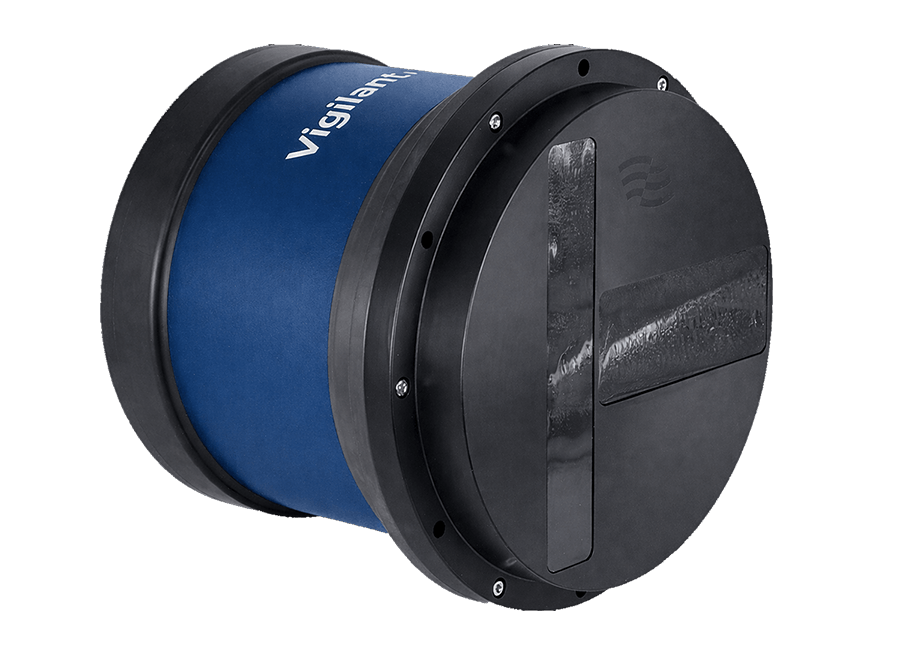
Forward-looking sonar is therefore a critical component of the XLUUV navigation architecture—and this is precisely the operational requirement addressed by Vigilant FLS 600.
Long-range detection that provides tactical reaction time
Speed and autonomy offer limited value if an underwater vehicle cannot detect hazards early enough to avoid them.
Vigilant FLS 600 provides active obstacle detection through the water column at ranges of up to 1,000 metres. For an autonomously navigating XLUUV, this is a tactically significant distance. It gives the vehicle’s command and control system time to detect and track a potential obstruction, assess the collision risk and execute an appropriate avoidance manoeuvre.
Earlier detection enables the vehicle to respond progressively rather than making abrupt course changes, aborting its mission or surfacing unnecessarily. This helps preserve both platform safety and mission continuity.
Real-time 3D bathymetry for littoral operations
As an XLUUV approaches a coastal operating area, the reliability of existing navigational charts can become increasingly uncertain. Survey information may be incomplete, out of date or insufficiently detailed, while sediment movement, seabed activity and man-made objects may have altered the local environment.
Vigilant’s 600-metre 3D bathymetric mode generates a high-resolution, real-time representation of the seabed ahead of the vehicle.
This enables the XLUUV to assess bottom clearance, identify changes in seabed gradient and plan a safe route through complex or poorly charted terrain. Instead of relying solely on stored hydrographic data, the vehicle can continuously update its understanding of the environment as the mission progresses.
The result is more assured autonomous navigation through precisely the shallow and constrained waters in which many strategically important missions must be conducted.
Passive acoustic awareness for covert missions
Vigilant also provides a passive acoustic capability for missions in which discretion is critical.
In passive mode, the system can capture and process broadband acoustic signatures generated by vessels, machinery and other sound-producing contacts. These data can support the detection, tracking and classification of nearby contacts without requiring the XLUUV to transmit an active sonar signal.
The combination of active and passive sensing gives the vehicle greater operational flexibility. Active sonar can provide detailed knowledge of the surrounding physical environment, while passive sensing can contribute additional awareness when minimising acoustic emissions is the priority.
A perception system for assured autonomy
An XLUUV must be able to do more than follow a predetermined route. It must perceive its surroundings, recognise emerging hazards and adapt its behaviour without depending on continuous intervention from a remote operator.
Vigilant FLS 600 provides the physical perception capability required to support that autonomy:
- long-range obstacle detection through the water column;
- high-resolution, real-time 3D bathymetric mapping;
- passive broadband acoustic sensing; and
- sufficient warning time for safe and controlled autonomous manoeuvring.
From deep-water transit to covert operations in complex littoral environments, Vigilant FLS 600 enables XLUUVs to operate with greater independence, safety and mission assurance in contested underwater domains.
Forcys, a global leader in underwater defence technology, and DRASS, a renowned name in the manufacturing of diving systems and underwater vehicles, have signed a Memorandum of Understanding (MoU) aimed at revolutionising underwater operations.
Forcys integrates and brings to the defence market world-changing solutions from leading technology partners Chelsea Technologies, EIVA, Sonardyne, Voyis, and Wavefront Systems. These companies are renowned for their innovative offerings in underwater and maritime operations, making them ideal partners for DRASS.
Luca Biasci, SDV & LUUV Program Manager at DRASS, emphasizes the significance of this collaboration: “DRASS has consistently been at the forefront of technological innovation in the underwater domain. With this partnership, Forcys’ robust portfolio of advanced payload technologies will be integrated with our Large Unmanned Underwater Vehicles (LUUVs), RONDA, expanding our suite of solutions to meet the evolving demands of the underwater sector.”
Under this agreement, Forcys’ advanced underwater vehicle systems and sensor payloads will complement DRASS’ capability to meet the evolving needs of navies.
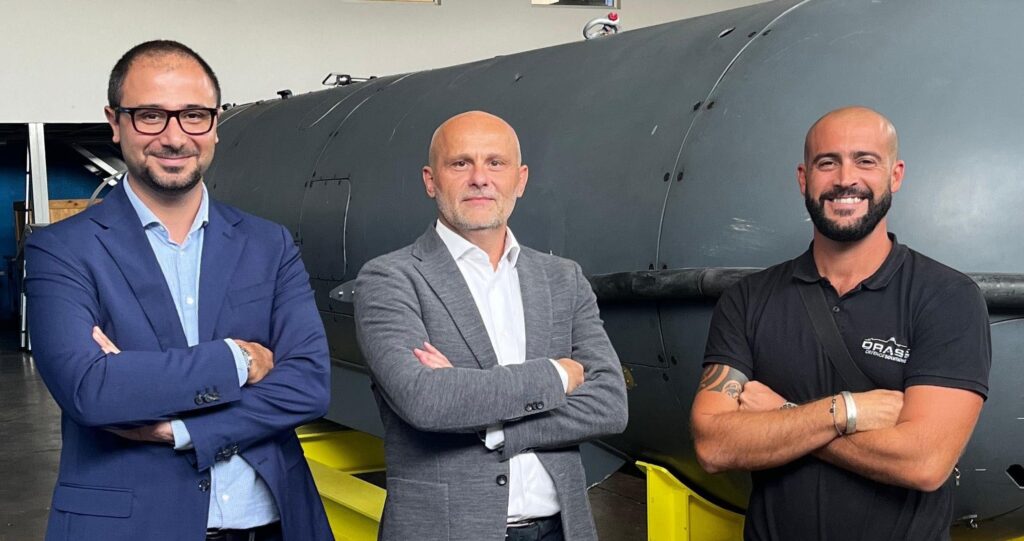
Antonio J. Belfiore, who leads sales in the Europe, Middle East, India, and Africa (EMEIA) region for Forcys, recently visited DRASS headquarters in Livorno, where the final details of the agreement were ironed out.
“We are thrilled to partner with DRASS, a company that shares our commitment to innovation and excellence,” said Antonio J. Belfiore. “This partnership allows us to combine our expertise and provides customers with state-of-the-art systems that enhance operational capabilities and ensure safety and efficiency in underwater missions.”
Both companies are committed to pushing the boundaries of what is possible in the underwater domain, leveraging their combined expertise to deliver state-of-the-art solutions to defence markets worldwide.
In brief
Just because your expeditionary forces operate small Autonomous underwater vehicle (AUV) systems, it doesn’t mean they should not be ambitious as to which payloads to carry. When deploying from a Rhib or other confined spaces, then low-logistic one-person operated instruments are a necessity. This requirement has seen the proliferation of small AUVs. In January of 2022 a number of this units manufactured by OceanScan-MST were delivered to Denmark’s Frederikshavn naval base. Though the AUVs are small, their payload requirements weren’t.
The challenge
The customer wanted to equip these AUVs with the latest generation of 4K digital stills cameras and 3D lasers. Fitting the equipment to an AUV already packed with sonar payloads and other navigation instruments is challenging. Fortunately our technology partner Voyis and their next generation optical systems were at hand. They had to work closely with OceanScan-MST to understand the constrains and develop the right mechanical design to integrate the popular Recon LS System.
The solution
The solution was to develop an OEM version of the Recon LS where each of the components was delivered and carefully integrated to the AUV. The integration to the platform is of paramount importance as the product has been very carefully designed to optimally illuminate the scene.
The result
The Light Autonomous Underwater Vehicle (LAUV) supplied by OceanScan-MST were equipped with an identification capability enabling each of the AUVs to search for contacts with the combined sonar and laser pair and enabling re-acquisition with the same AUV. This means improved probability of detections, increased area-coverage-rates and mission tempo and imaging with an amazing fidelity to support other missions beyond mine countermeasures.
If you would like to know how Forcys and its technology partners can support your expeditionary needs please do not hesitate to get in touch.