An interview with Dr. Rob Crook, Research Director, Sonar Systems here at Forcys.
Solstice Multi-Aperture Sonar, or as we call it, Solstice MAS is a product of a rethink of side scan technology from the bottom up.
It aims to blend the high resolution of Synthetic Aperture Sonar (SAS) with the robustness and the reliability of side scan. The high-quality imagery is dependent on more than just high resolution. Solstice is therefore designed to provide not just high resolution but high SNR and contrast too. To achieve this, Solstice is built around five key technologies. In this interview, we’ll concentrate on Multi Ping Multi Look (MPML) and how this distinguishes Solstice MAS from SAS.
Q. Before we look at Solstice MAS and its advantages over traditional sidescan and synthetic aperture sonar systems, could you please briefly explain what these two actually are?
Sidescan sonar dates back to the 1970s and it’s become a workhorse technology used for commercial surveys or for search, classification, and mapping type MCM operations. It creates useful imagery of the seabed and objects which lie on it.
The longer the array of hydrophones or aperture used by the sidescan sonar, the better the picture resolution. Higher operating frequencies create higher resolution imagery, but that’s at the expense of range. Synthetic aperture sonar, or SAS, seeks to improve this resolution by synthesizing an aperture in the signal processing far longer than the actual physical sonar array. Also, SAS tends to operate at a considerably lower frequency, which helps extend its range.
Q. What experience do Forcys have in this technology?
Our engineers at Forcys have considerable experience in designing and developing synthetic aperture sonar systems. Two of our principal designers led the hardware development for NATO’s so-called MUSCLE SAS program and also led the development of a SAS system for a major international defense company.
Forcys, through Wavefront Systems, acted in a design consultancy role for several other SAS projects over the past decade. From this experience, we’ve learned that SAS can be very effective, but it is not without its drawbacks. It’s relatively expensive, heavy, and power-hungry, and in some fairly commonplace scenarios, SAS can be fragile.
Q. What do you mean when you say SAS can be fragile?
SAS can produce impressive results in the right conditions, such as deeper deployments away from the surface effects or when deployed on larger, more stable platforms. However, SAS can struggle in very shallow water—less than 40 feet deep—or when deployed on smaller, say 9 or 12-inch diameter AUVs. In these situations, feedback from users suggests SAS performance can degrade significantly.
Q. And what would that degradation look like and why does it occur?
Some SAS systems can compromise as much as 50% of their claimed swath in shallow water, or default to the poor resolution associated with its real aperture length when the coherent processing fails. The quality of this data is rarely of operational use and missions have been compromised as a result.
As to the why: SAS performance is adversely affected by higher-order multipath interference commonly encountered in shallow water scenarios. Its performance is degraded by unknown or dynamic sound velocity profiles. It demands high-accuracy bathymetry, without which non-linear platform trajectories will not produce focused images, and it struggles to provide reliable performance, particularly in high cross-currents, due to the impact these have on the SAS micro-navigation.
Now, some of these issues aren’t unique to SAS, of course, but because SAS seeks to extend the range of conventional sidescan sonar, they have a far greater significance for SAS.
Q. And what are the associated operational issues with SAS?
Large, heavy, power-hungry systems; complex mission planning due to its achievable range being dependent upon its speed—with higher speeds reducing available ranges—and often unmanageable quantities of real-time data making real-time processing problematic.
Q. Okay, so tell us, what did you do?
We decided to completely rethink the sidescan tech from the bottom up with the aim of developing a sensor which blended the high resolution of SAS with the robustness and reliability of sidescan.
Q. So, tell us more about Solstice.
Well, high-quality imagery is dependent on more than just high resolution. Solstice is therefore designed to provide not just high-res, but high SNR (signal-to-noise ratio) and contrast. To achieve this, we designed Solstice around five key technologies: MSAT (Multipath Suppression Array Technology), RAC (Real-time Auto Calibration), Motion Compensation, Pixel Perfect Imaging, and last but certainly not least, multi-ping multi-look.

Q. Is this last core technology the one that most clearly distinguishes MAS from SAS?
Yes, it’s what makes MAS unique and distinct from SAS for sure. Our multi-ping multi-look tech incoherently combines returns from multiple pings to greatly enhance the image signal-to-noise ratio, which in turn greatly reduces the distracting speckle-type noise so common in SAS imagery.
This ability to integrate incoherently allows our multi-aperture processing to be far less affected by navigational inaccuracies. This makes Solstice’s imaging performance in shallow water environments on smaller, less stable vehicles far more robust.
Of course, design decisions like this come with trade-offs. In this case, incoherent multi-aperture processing doesn’t increase the image resolution as the multiple apertures are processed, but MAS largely offsets this effect by using a much higher operating frequency than a typical SAS. Its natural real aperture resolution is therefore much better—a better starting point, you might say.
Q. Just to be clear, can you explain precisely what you mean by coherent and incoherent processing, and how are they different?
So, SAS coherent processing uses both the signal phase and amplitude information. Multi-ping multi-look uses incoherent processing, meaning only the amplitude is used for processing of the multiple apertures.
Q. Now what are the operational advantages of Solstice MAS?
Solstice has the ability to image large areas of the seabed at significantly higher ground speeds than SAS. Its low 20-watt power draw dramatically extends search, classify, map mission durations for AUVs, and this allows the sonar to be used alongside identification systems such as Voyis’s laser line scan in our latest L3Harris IVER4 Recon module.
Mission planning is simplified due to the constant range swath, and that all the advanced MAS processing can be performed on board the vehicle itself in real time, producing manageable quantities of data that are available for third-party software packages such as automated target recognition algorithms.
Q. Are you continuing to develop Solstice and can you share any future developments?
We pride ourselves on maintaining relationships with our end customers, listening to their real-world experiences of sensor tech, and using this information to help guide our development and improve our products.
The latest addition to the Solstice family is a bigger brother, Solstice MAS 4000. It’s now being sea trialled and has already achieved SAS-like along-track resolution within a power budget of just 24 watts.

Explosive ordnance, such as mines, pose a significant threat to naval operations, offshore energy projects, and other maritime activities. Traditional methods of disposing of these hazards often put personnel and equipment at risk as they require divers or remotely operated vehicles (ROVs) to approach the ordnance closely and manually initiate the detonation process.
The Initiation Transponder 6 (IT 6) from our technology partner Sonardyne, when integrated with mine neutralisation devices mounted on a VideoRay Mission Specialist Defender underwater robot, provides a remote, autonomous, safe and effective solution for mine clearance operations. This technical collaboration allows for acoustic initiation and detonation from a remote location, eliminating the need for and risks associated with physical proximity to the ordnance.
The integration of the Defender and mine neutralisation devices with the IT 6 represents a significant advancement in the field of explosive ordnance disposal (EOD).
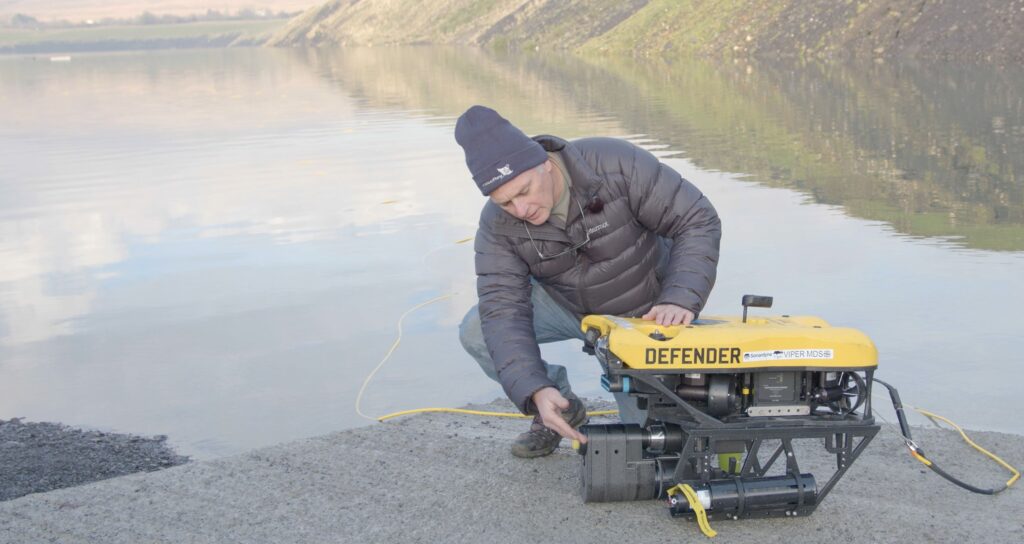
How it works:
- The IT 6 is connected to a non-electric mine neutralisation device, which is deployed near the contact by the Defender.
- Once the neutralisation device is in place, the Defender can be manoeuvred to a safe distance, typically around 1 kilometre away.
- Using Sonardyne’s Wideband 2 digital signal technology, the IT 6 receives an acoustic command to arm the charge from a surface vessel or command centre. A subsequent command then initiates the shock tube and detonates the neutralisation device.
- The entire process can be carried out in most weather conditions and during day or night, enhancing operational flexibility and safety.
Benefits:
- Enhanced safety: By eliminating the need for physical proximity to the contact during detonation, the combination of the IT 6 and Defender significantly reduces the risk to personnel and assets.
- Increased operational efficiency: The autonomous delivery and wireless initiation capability streamlines the process, allowing for faster and more efficient mine clearance operations.
- Versatility: The IT 6 and Defender can be used in various underwater environments, including deep-water operations, making it suitable for a wide range of clearance missions. The underwater robot is designed for more precise control of the vehicle position and orientation, heavier payloads and demanding interventions. With seven thrusters, it can move in any direction and maintain active pitch to face its target in an upward or downward orientation.
- Proven technology: Sonardyne’s Wideband 2 digital signal technology draws on a fifty-year heritage; it is field-proven, ensuring reliable and long-range underwater wireless communication. The Defender draws on VideoRay’s twenty-five years of ROV design experience and is built with power, reliability and flexibility in mind.
- Multi-shot: the IT 6 can be fired multiple times, making deck tests and practice runs affordable. In addition, if a mission is aborted the kit can be safely recovered and reused. The explosive charge and the IT 6 are only sacrificed on confirmed contacts.
- Cost: Once the initial investment has been made for the technology, the cost per deployment is significantly lower than sending personnel on each mission. If multiple ROVs are deployed, they can be controlled from one vessel or control room, thus further reducing costs.
Demonstration
In 2022, the IT 6 and the Defender were demonstrated together for the first time to the UK’s Defence Science and Technology Laboratory (DSTL) and the UAE Navy at a quarry in Wales.
The demonstration included successful detonations of a mine neutralisation device, delivered by the Defender and initiated by the IT 6, from a range of approximately 1 kilometre.
As armed forces around the world move towards more autonomous operations on land, in the air and under the sea, there will be increased demand for the utilisation of existing and the development of new technology.
The benefits in terms of safety, efficiency, adaptability and cost are obvious, not just in mine countermeasures; and the collaboration between market leaders, such as Forcys, Sonardyne and VideoRay, will be at the forefront of driving advances in the technology. Contact us to see how we can help you be there too.
_______________________________
Did you know that another of our technology partners, Voyis, manufacture the market’s technically leading ROV piloting camera? The Discovery camera from Voyis enhances your identification by delivering crisp 4K images of your targets in real-time. The ideal complement to the IT 6 and Defender. Find out more in a blog coming soon…
In brief
Just because your expeditionary forces operate small Autonomous underwater vehicle (AUV) systems, it doesn’t mean they should not be ambitious as to which payloads to carry. When deploying from a Rhib or other confined spaces, then low-logistic one-person operated instruments are a necessity. This requirement has seen the proliferation of small AUVs. In January of 2022 a number of this units manufactured by OceanScan-MST were delivered to Denmark’s Frederikshavn naval base. Though the AUVs are small, their payload requirements weren’t.
The challenge
The customer wanted to equip these AUVs with the latest generation of 4K digital stills cameras and 3D lasers. Fitting the equipment to an AUV already packed with sonar payloads and other navigation instruments is challenging. Fortunately our technology partner Voyis and their next generation optical systems were at hand. They had to work closely with OceanScan-MST to understand the constrains and develop the right mechanical design to integrate the popular Recon LS System.
The solution
The solution was to develop an OEM version of the Recon LS where each of the components was delivered and carefully integrated to the AUV. The integration to the platform is of paramount importance as the product has been very carefully designed to optimally illuminate the scene.
The result
The Light Autonomous Underwater Vehicle (LAUV) supplied by OceanScan-MST were equipped with an identification capability enabling each of the AUVs to search for contacts with the combined sonar and laser pair and enabling re-acquisition with the same AUV. This means improved probability of detections, increased area-coverage-rates and mission tempo and imaging with an amazing fidelity to support other missions beyond mine countermeasures.
If you would like to know how Forcys and its technology partners can support your expeditionary needs please do not hesitate to get in touch.